> ## Documentation Index
> Fetch the complete documentation index at: https://docs.cura.so/llms.txt
> Use this file to discover all available pages before exploring further.
# What workflows do
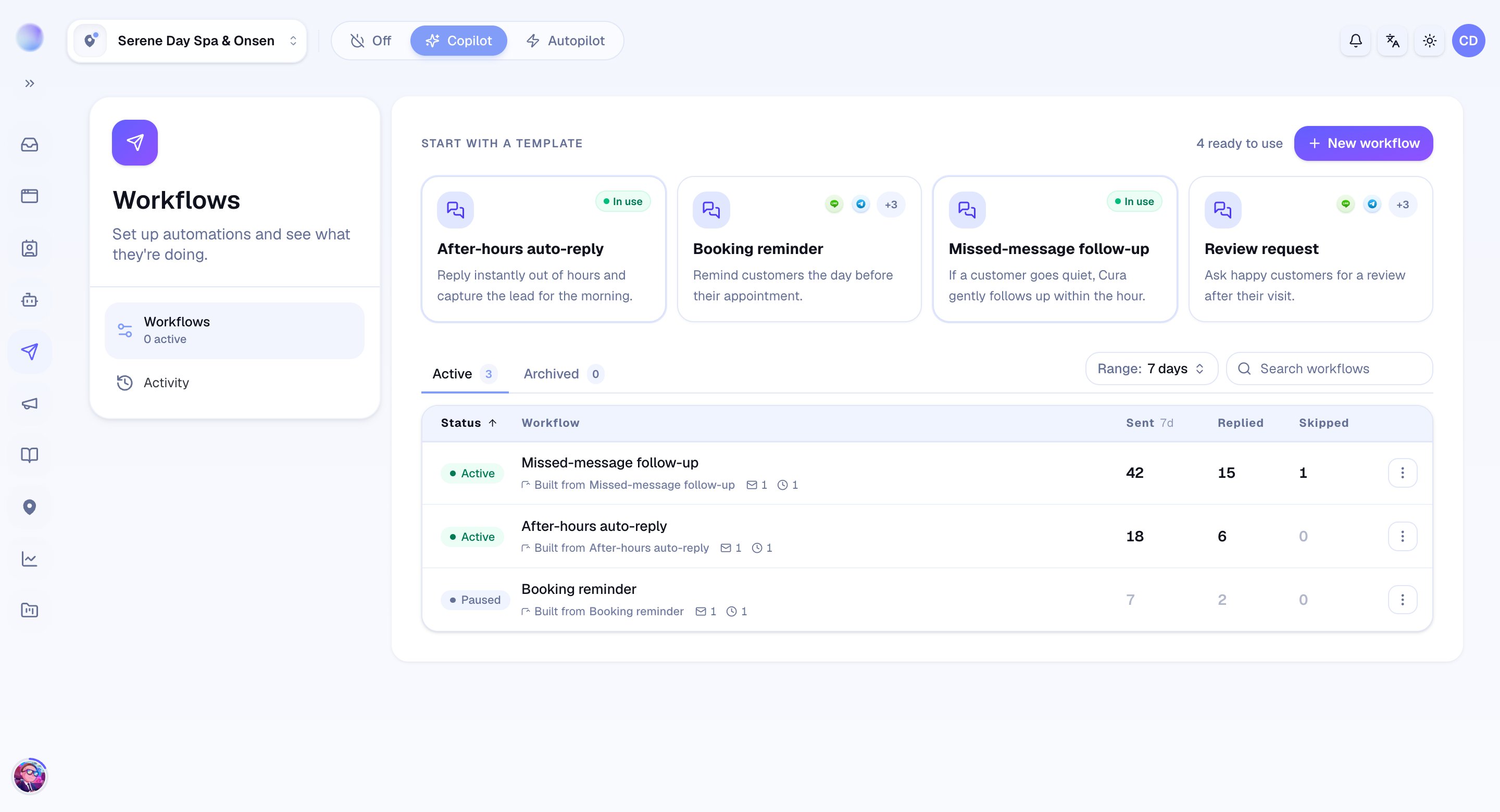
> Workflows are Cura's way of handling the follow-ups you'd otherwise forget — appointment reminders, post-visit check-ins, re-engaging quiet customers — automatically, in the customer's own channel.
Workflows are Cura's way of handling the follow-ups you'd otherwise forget — appointment reminders, post-visit check-ins, re-engaging quiet customers — automatically, in the customer's own channel.
Think of a workflow as a small assistant that watches for a moment (a booking is made, a message goes out) and then takes care of the rest on its own. You don't write code or build anything from scratch. Cura provides ready-made workflows; you decide which ones to switch on and how they behave for your business.
***
## A workflow is a ready-made automation you enable
Each **workflow** starts as a template that Cura's team has designed and tested — a trigger paired with a sequence of actions. Your job isn't to build it; it's to **enable** the ones you want and fill in a few details, like the message wording or how long to wait. The recipe is already proven, so you get a working automation in minutes.
You browse these templates in the **workflow gallery**, grouped by what they help you do: **Engage customers**, **Capture & qualify**, and **Organize conversations**. Pick the goal you're after, open a template, and switch it on.
 ## Triggers decide when it runs
Every workflow begins with a **trigger** — the event that wakes it up. A workflow might start when an **appointment is booked**, when one is **cancelled** or **rescheduled**, after a **consultation completes**, when a customer **goes quiet**, or after your **last message** goes out. One trigger, one starting point. (More on this in [Choosing triggers and actions](/workflows/triggers-and-actions).)
## Actions decide what happens
Once triggered, the workflow runs through its **actions** in order — usually some combination of waiting and sending a message. A reminder workflow, for example, might wait until the day before an appointment, then send a friendly confirmation on the customer's channel.
## It respects each channel's rules
Cura sends through whichever channel the customer last used — LINE, WhatsApp, Instagram, Messenger, and more. Each platform has its own rules about messaging customers outside a recent conversation, and Cura follows them automatically. If a channel won't allow a message at that moment, the run is safely stopped rather than risking your account.
Start with one workflow — an appointment reminder is the most popular first choice. Once you see it working, layer on follow-ups and re-engagement.
## You stay in control
Workflows never replace you. You choose which ones are **On**, which channels they apply to, and exactly what they say. You can turn any workflow off at any time, and you can watch every run and its results from one place. And if a customer replies while a workflow is mid-run, Cura automatically stops it so the automation never talks over a live conversation.
A workflow only ever acts inside conversations on the channels you've scoped it to. Nothing runs business-wide unless you choose that.
***
### Related articles
* [Enabling and configuring a workflow](/workflows/enable-and-configure)
* [Choosing triggers and actions](/workflows/triggers-and-actions)
* [Scoping a workflow to specific channels](/workflows/scope-to-channels)
* [Monitoring workflow runs and analytics](/workflows/monitor-runs-and-analytics)
## Triggers decide when it runs
Every workflow begins with a **trigger** — the event that wakes it up. A workflow might start when an **appointment is booked**, when one is **cancelled** or **rescheduled**, after a **consultation completes**, when a customer **goes quiet**, or after your **last message** goes out. One trigger, one starting point. (More on this in [Choosing triggers and actions](/workflows/triggers-and-actions).)
## Actions decide what happens
Once triggered, the workflow runs through its **actions** in order — usually some combination of waiting and sending a message. A reminder workflow, for example, might wait until the day before an appointment, then send a friendly confirmation on the customer's channel.
## It respects each channel's rules
Cura sends through whichever channel the customer last used — LINE, WhatsApp, Instagram, Messenger, and more. Each platform has its own rules about messaging customers outside a recent conversation, and Cura follows them automatically. If a channel won't allow a message at that moment, the run is safely stopped rather than risking your account.
Start with one workflow — an appointment reminder is the most popular first choice. Once you see it working, layer on follow-ups and re-engagement.
## You stay in control
Workflows never replace you. You choose which ones are **On**, which channels they apply to, and exactly what they say. You can turn any workflow off at any time, and you can watch every run and its results from one place. And if a customer replies while a workflow is mid-run, Cura automatically stops it so the automation never talks over a live conversation.
A workflow only ever acts inside conversations on the channels you've scoped it to. Nothing runs business-wide unless you choose that.
***
### Related articles
* [Enabling and configuring a workflow](/workflows/enable-and-configure)
* [Choosing triggers and actions](/workflows/triggers-and-actions)
* [Scoping a workflow to specific channels](/workflows/scope-to-channels)
* [Monitoring workflow runs and analytics](/workflows/monitor-runs-and-analytics)